Showing posts with label PRO. Show all posts

Monday, February 6, 2017

Head To Head - Olympus EM1 Mark II Versus Nikon D500 Shooting Hockey


Hockey is arguably one of the hardest sports to photography because of the speed and unpredictability of the action.

I've always wanted to be able to photograph the Columbus Blue Jackets.  As luck would have it, Midwest Photo Exchange offered a photo workshop to shoot the Blue Jackets.

Before we get into the gear stuff, let me just take a minute to throw out some kudos to the following:

Midwest Photo crew Matt and Ken
Great hosts and supported the learning, being there to help with gear and shooting questions whenever someone needed it.  MPEX Website

Tim Neumann of Soft Light Studios
The main presenter and educator for this workshop.  He made sure that everyone was brought along on the journey.  We had some attendees that had very little photographic experience all the way through to professionals.  Tim was able to cover the basics of making the shooting experience a success for all involved.

Kyle Robertson, Columbus Dispatch Photographer
Kyle shared his expertise and experience shooting assignments and games at Nationwide Arena as well as other sporting events.  Kyle's Twitter Feed

Joshua, Columbus Blue Jackets Liason
Joshua was there for us throughout the event.  A great host, he also took us on an arena tour.

Gear For The Night
Nikon D500 / Tamron 70-200/2.8 VC
Olympus OMD EM1 Mark II / Olympus 40-150/2.8 PRO / MC-14 TC


Now let's get down to it.  You know you want to know all about it.

I'll help you out so you don't need to read through a lot of "junk".  I could pine on and on about all kinds of technical stuff.

Bottom line - I preferred shooting with the Nikon D500 over the EM1 Mk II.  The Nikon/Tamron combo just focused faster, stayed on target (I can't find an out of focus shot that was not my fault or was through the safety net).  The higher ISO was cleaner on the D500.


The Olympus may be suffering because I am still learning it's newer features and auto focus methods.
Still more testing to determine that.  Might also have been the lower light conditions gave the AF some issues.

Pub Match Images With the EM1 Mark II

1/1000, f/2.8, ISO 1600 @ 150mm

1/1000, f/3.2, ISO 1600 @ 150mm

1/1000, f/3.5, ISO 1600 @ 150mm

1/1000, f/3.2, ISO 6400 @ 150mm

1/500, f/2.8, ISO 2500 @ 150mm

Pub Match with Nikon D500

1/1000, f/3.5, ISO 2000 @ 200mm

1/1000, f/3.5, ISO 1600 @ 200mm

1/1000, f/4, ISO 2500 @ 200mm

1/1000, f/3.5, ISO 1600 @ 175mm


Battery Life

Each camera took about 1000 images over the course of the day, shooting 2 full hockey games.  A pub match early in the day as well as the Blue Jackets v Devils game at the end of the day.

Nikon battery was at 57%
Olympus battery was at 46%

Not bad, considering older mirrorless cameras, I probably would have gone through 2 or 3 batteries.  This includes any image review I did on the LCD.

Weight

I've never been one that was concerned about camera weight.  To be honest, while I noticed that the Nikon/Tamron combo were larger and heavier, handling between the 2 never really was improved or hampered by the weight or lack there of in either.

When in use, both cameras were supported by a Black Rapid strap.

CBJ versus NJ Devils - Olympus EM1 Mark II
1/640, f/4, ISO 1600 @ 155mm(MC-14)

1/320, f/2.8, ISO 1600 @ 150mm

1/1000, f/2.8, ISO 1600 @ 150mm

1/800, f/2.8, ISO 1000 @ 150mm

1/800, f/4, ISO 2500 @ 210mm (MC-14)

1/800, f/4, ISO 2500 @ 210mm (MC-14)


Nikon D500
1/1000, f/3.5, ISO 1250 @ 200mm

1/1250, f/3.5, ISO 1100 @ 165mm

1/1000, f/3.5, ISO 1000 @ 200mm

1/1000, f/3.5, ISO 1100 @ 200mm

1/1000, f/2.8, ISO 900 @ 200mm

1/1000, f/3.2, ISO 1250, @ 200mm


IBIS vs VC
Shutter speeds for the night were between 1/500 and 1/1000 when shooting action, so the IBIS/VC was never really used.  There were some shots that were more portrait-like, so the shutter speeds went down some and we can see there that the Olympus EM1.2 IBIS works very well.

End of the day, there were times when I was wanting some longer reach on the D500, so I tried using the 1.3x crop within the D500.  It worked rather well, provided you remember to keep the subject within the box boundary within the viewfinder.  Even without the in camera crop, the full DX files were great to use and could be cropped into a lot without losing IQ.

The Olympus high fps modes seemed like they would be a great asset.  I used the 15fps mechanical as well as the 60fps e-shutter.  Had some decent success there.  Tried AF in both single point and 3x3 box.  Also decent results there.  While initial AF acquisition is much improved over the EM1.1, it still was not close to the D500.  There were some initial frames that were out of focus and at times some frames in the middle of the burst would be slightly out of focus.

Again, as I said when we started off, shooting hockey is probably one of the most difficult action sports to shoot.  It may just be that this was a little too much for the EM1.2.

The confidence was just not as high with the Olympus kit as it was with the Nikon.

Shooting Conditions
We were able to pretty much shoot where ever we wanted to during the pub match.  We had access to the camera deck next to the broadcast video cameras as well as down in the put to shoot through the special ports in the glass.

During the NHL game, we were up in a special suite that was a little bit further back and more toward one corner.  A little but further away than earlier in the day, but a great vantage point to shoot from.

Just as an added bonus, here are a few images I got during the arena tour.

These were taken with the Olympus EM1 mark II and Olympus 9-18mm f/4-5.6


Friday, April 17, 2015

Olympus 12-40mm f/2.8 PRO Lens Review

Previously, the only wide to medium zoom lens for m43 we had was the Olympus 12-50/3.5-6.3.  While a decent, versatile kit lens, it does not favor shooting in low lighting conditions based on its variable and comparatively slow aperture range.

1/1600, f/6.3, ISO 200 @ 12mm
While we do have primes that pretty much cover the range we are looking at with the 12-40/2.8, having a fast zoom is great for those times when you cannot or do not want to change lenses.
1/500, f/4, ISO 200 @ 26mm
Image Quality
Like the 40-150/2.8 PRO, I can't really find a lot of fault with the IQ at any aperture or any focal length.  You have your normal IQ drop off at f/11 and above due to diffraction, but beyond that, I find it stellar.  There is some noticeable barrel distortion at 12mm, but nothing that a run through Lightroom and the lens correction module can't handle.

The bokeh is pleasing when you are focusing up close.  Based on the sensor size we are working with anything focused on at further distances gives you lots of in focus areas.  The bokeh isn't bad, but your not going to get a lot out of focus either.

From the sample images, shot wide open and in the challenging conditions, this lens is fantastic in the IQ department.

1/320, f/4, ISO 200 @ 15mm
Handling
This thing is small when you think about what you are getting in the exposure department.  A 12-40 f/2.8 focal length,  You get a 24-80 field of view.

The zoom ring is smooth and dampened and feels every bit a pro grade lens as the name Olympus gave it implies.

The focus ring is smooth and moves from one point to the other very quickly.  I like the AF/MF clutch as well for those times when you want to quickly switch over to MF.  No menu diving and you get the added bonus of snap focusing.

1/2500, f/4, ISO 200 @ 24mm
Weight
Compared to the 12-50mm lens, this one is on the heavy side.  Compared to an APS-C or 135 equivalent f/2.8 lens, it is down right small and light.  hand holding this lens on an EM1 or EM5 with after market grip is easy.

1/2000, f/2.8, ISO 200 @ 40mm
Auto Focus Speed
Single point AF is lightning fast in all but the poorest of light.  Even in poor light, though it is slow, but tends to hit the mark.  There is some hunting, but only when the lighting is so dark it is hard to see your target with the naked eye.  At that point any camera system is going to struggle

Continuous AF
 works great!  I've not had an opportunity to see what the lens did pre firmware 3.0 on the EM1, but I've never heard of any complaints from anyone about it.  I might take some time and see how it performs on the EM5 as a comparison.

Close focusing is also another plus of this lens.  It is not macro level, but like the 40-150/2.8, you can get right up close, I believe that you can get 4cm from the front element!!

1/200, f/4, ISO 200 @ 31mm
Lens Hood
The hood is reversible and has a positive locking mechanism.  There are 2 buttons on the hood that must be pressed before the hood can be twisted for removal.  You'll not be losing this one accidentally.  It is kind of shallow, but can provide some front element protection and shading.  It is in no way as deep as the one that comes with the 40-150/2.8

1/80, f/4, ISO 640 @ 40mm
Conclusion
So far, just from this one day of shooting and seeing the results, I am sold on the capability of this lens.  It is sharp, handles well, everything is in a great place and the AF performance is top notch.  I'm not sure if Olympus could have made a better wide to medium telephoto zoom lens.

As much of a winner as this lens is, it is expensive when compared to other zooms in the same focal range.  However, this is a pro grade lens, while the others are not (except the Panasonic 12-35/2.8, which is a great lens in its own right).

Wednesday, March 18, 2015

More Olympus 40-150mm f2.8 - Deeper Down The Rabbit Hole

Previously, I wrote about my initial impression with the Olympus 40-150/2.8 PRO lens.  That encounter had some unique challenges, such as having to shoot through glass - but the positive side was that the lighting was great.  This write up will also encompass some of the new EM1 firmware update (3.0) as well.

The Arnold Fitness Expo was in town again March 6-8, so I made the call that I would shoot this years event with my Olympus gear.  I wanted to do this to once and for all satisfy my curiosity on just how well this Olympus gear would function in a high pressure, fast paced shooting environment.

The team sat down and we mapped out what we wanted to cover over the 3 days. 


With schedule in hand we showed up on day 1 bright and early to get a decent place in the media pit area of the main expo stage. Both the EM1 and EM5 worked extremely well with the 40-150/2.8 and various Olympus prime lenses (17/1.8 & 25/1.8) in the adequately lit stage.  We had no problems getting the images we wanted of the arm wrestling, bodybuilders and strongman competitors.  The EM1 had the latest 3.0 firmware installed and you can definitely tell a big difference in the C-AF capabilities of the camera.  The 40-150 was quick and sure and just nailed focus time after time.  We were able to shoot it at f/2.8 for the majority of the time and our ISO was floating between 200 and 640.


There were some instances where we were using C-AF, but most of the activities on stage S-AF was doing a stellar job.


Day 2 was met with venues in light less optimum than day 1.  Our first event covered was fencing.  A hotel ballroom area was converted into rooms with multiple stages for fencing matches.  In these rooms, fluorescent lights predominated and our ISO got pushed up a bit further.  Also, in some of these areas, the 40-150 was too tight of a field of view, so the primes were employed more.  There were instances where the 40-150 was utilized, but they were more supporting shots for the fencing story than the actual action shot.  Still, the 40-150 performed admirably, nailing focus again and again and with great speed.  So far, I'm not missing my Nikon setup.  All appears to be going well with the Olympus gear.  More C-AF was employed due to the erratic nature of the fencing subjects.


We also covered some some stage events on day 2, like MAS wrestling and some martial arts demonstrations.  Lighting was about the same as the ballrooms for fencing.   Performance was still there.


Day 3 takes us off the beaten path and onto the Ohio State Fairgrounds where the kids expo, cheer and dance, and equestrian events took place.


Not much more to be said about the coverage of the kids expo and the cheer and dance areas.  Lighting there was more like the main expo stage, adequate for our needs.  The cheer competitions have a lot more unpredictable movements, which caused me to work harder at keeping the C-AF locked onto a subject.  Single point C-AF did well, but I wasn't able to keep the subjects on that one point as well as I would have liked.  So, I started to employ the 9 point C-AF and started to get a lot more keepers.  The trick is, though, that the initial lock must be good.  I noticed that there were times that the initial lock on the 9 point AF box would not be on what I wanted.  I also tried C-AF with tracking, but it got lost in the sea of similar uniforms.  I noticed thought that the C-AF with tracking might be a good alternative for video as it can track a subject moving around the frame, allowing for smoother camera movements in all directions.


Where we seem to have hit a snag and found the limitations of the EM1 and the 40-150/2.8 was during the equestrian events.  The arena was indoors and lit by old sodium vapor lights.  Those lights were high up in the stadium ceiling and were bouncing off the thick arena dirt floor.  Needless to say, the color pallet was just horrible and muddy, with low contrast.  It made for a noticeable decline in AF speed and really taxed the C-AF tracking ability.  It did it's job and I can tell I still need some more trigger time learning how the EM1 tracks focus.  The real issue I had was needing to push the ISO up into the 5000 ISO range.  This is a situation where the larger sensor of the FX Nikons would probably have been a better fit for the shooting environment.

So bottom line, I only ran into one small snag and it as not something so monumental that I cannot be overcome.  The 40-150 showed that it is a definite work horse of a lens and up there with any of the other makers PRO line of lenses.

Sunday, March 1, 2015

The New Olympus 40-150mm f/2.8 PRO Lens Revew

Looks like our work with the Olympus gear keeps increasing!

For those who may not be aware, I had one of my images taken with Olympus gear used in an email advertisement and that same image may potentially be used in print ad campaigns.  Given this, I had some talks with Olympus America (a great crew of people over there) and they gave me a great deal on the Olympus 40-150mm f/2.8 PRO lens.

Out of all the zooms for Olympus, this is the one that I had most interest in using.  For the wider to medium focal lengths, the primes seem to fit the bill quite nicely.  

I have coverage of the Arnold Classic coming up soon and this year decided with the acquisition of the Olympus gear that I would try to shoot it Olympus only.

Last year I shot the Arnold with Nikon, using the 24 and 50 primes and the 80-200/2.8 zoom.  We knew we would need a fast longer zoom, so we started looking.  The 40-150/4-5.6 and 75-300/4.8-5.7 we already had would be too slow, so the 40-150/2.8 seemed like the perfect choice.

Here are some sample images that will show the sizes of different 135 lenses versus the m43 40-150/2.8 PRO.  Please forgive the crappy cellphone captures of the images.  :D

Left to right:
Tamron 70-300/4-5.6 VC, Olympus 40-150/2.8 PRO, Nikon 80-200/2.8D
No lens hoods
Tamron 70-300/4-5.6 extends when zoomed.  Olympus does not. The Tamron would not stay extended sitting in this position.
Tamron 70-300 and Olympus with the hood added on.
Before shooting any major events, I always like to test out new equipment.  So first outing, took the lens to the Columbus Zoo and Aquarium.
Remember that I don't do charts and pixel peeping.  I review a lens based on what it is capable of providing me as an end result.  Keep that in mind when reading further.

Some notes:
I did not get the chance to shoot this lens with the newest firmware on the OM-D EM-1.  It was still version 2.2.  A lot of the habitats have glassed in viewing areas.  While better than fences in some instances, they tend to be very dirty and can degrade final image quality.

Image Quality
I can't really find a lot of fault with the IQ at any aperture or any focal length.  You have your normal IQ drop off at f/11 and above due to diffraction, but beyond that, I find it stellar.

The bokeh is also really nice and smooth.

I think you can see from the sample images above, that shot wide open and in the challenging conditions, this lens is fantastic in the IQ department.
Nanuq and Aurora flirting
1/1600, ISO 200, f/2.8 @ 46mm
Handling
First impression was that it feels an awful lot like shooting with the Nikon 80-200/2.8, but without the bulk.  

The zoom ring is smooth and dampened.  It is a little stiffer than the 80-200, which I am able to change the focal length with one finger.  The Olympus required a solid grip and turn, but you definitely will not move it accidentally.

The focus ring is smooth and moves from one point to the other very quickly.  I like the AF/MF clutch as well for those times when you want to quickly switch over to MF.  No menu diving and you get the added bonus of snap focusing.  For those curious, the MF ring does have hard stops at either end.

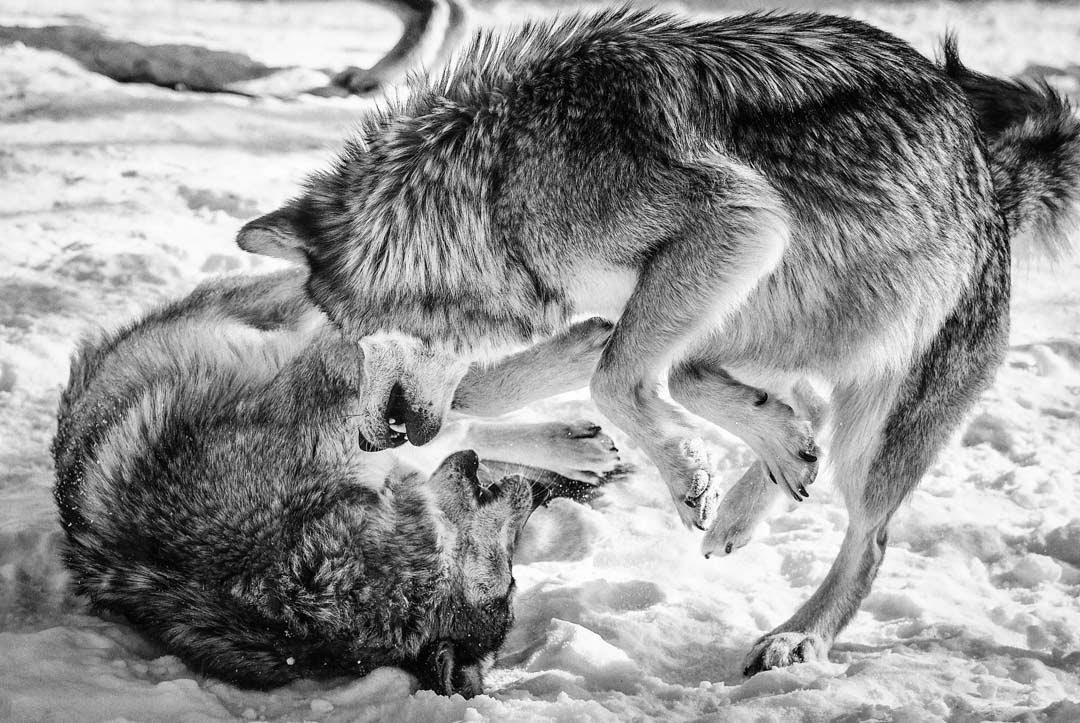
Mexican Wolves playing in the snow
1/2000, ISO 200, f/2.8 @ 64mm
Tripod Ring
The tripod ring is convenient as it can be removed if you don't need it.  What I like is the ability to rotate the ring all the way around the  lens, so you can get it out of the way when you are shooting with it handheld.  It also feels very stable, so should be solid when used on tripods.

Aurora the polar bear
1/1600, ISO 200, f/2.8 @ 150mm
Weight
Compared to other m43 lenses, this one is on the heavy side.  Compared to an APS-C or 135 equivalent f/2.8 lens, it is down right small and light.

Humbolt Penguins
1/1250, ISO 200, f/2.8 @ 82mm (cropped)
Auto Focus Speed
Single point AF is lightning fast in all but the poorest of light.  Even in poor light, though it is slow, but tends to hit the mark.  There is some hunting, but only when the lighting is so dark it is hard to see your target with the naked eye.
Continuous AF worked much better than expected, even given shooting through glass, which was our first shooting experience.  With the EM1 firmware at 2.2, a DSLR is still going to out focus it.  Once we get a chance to run it with the 3.0 firmware, we will let you know if there is a definite difference and what those differences are.

As it stands, the AF is so good and quick that you can hit most sport shots with just that.  CF was used without the tracking option and it was adequate for use in non-mission critical uses(again, with the 2.2 firmware).  There were some missed sequences, but given the shooting conditions, I'm not sure if the misses were the lens, my lack of experience using the m43 C-AF systems or the dirty glass I was shooting through.  If there is any deficiency that we find we will report it.

AF capable of keeping up with these running Mexican Wolves
1/3200, f/2.8, ISO 800 @ 150mm(heavily cropped as well)
Lens Hood
I like the fact that the lens hood can be retracted with a twist of the ring.  It stays locked in the deployed position until you use the ring.  I wish it did the same when retracted.  There were times just pulling the lens out of the bag that the hood would deploy.  That is just me being nitpicky, though.

Conclusion
So far, just from this one day of shooting and seeing the results, I am sold on the capability of this lens.  It is sharp, handles well, everything is in a great place and the AF performance is top notch.  I'm not sure if Olympus could have made a better lens.