Not much more to be said about the coverage of the kids expo and the cheer and dance areas. Lighting there was more like the main expo stage, adequate for our needs. The cheer competitions have a lot more unpredictable movements, which caused me to work harder at keeping the C-AF locked onto a subject. Single point C-AF did well, but I wasn't able to keep the subjects on that one point as well as I would have liked. So, I started to employ the 9 point C-AF and started to get a lot more keepers. The trick is, though, that the initial lock must be good. I noticed that there were times that the initial lock on the 9 point AF box would not be on what I wanted. I also tried C-AF with tracking, but it got lost in the sea of similar uniforms. I noticed thought that the C-AF with tracking might be a good alternative for video as it can track a subject moving around the frame, allowing for smoother camera movements in all directions.
Wednesday, March 18, 2015
More Olympus 40-150mm f2.8 - Deeper Down The Rabbit Hole
Not much more to be said about the coverage of the kids expo and the cheer and dance areas. Lighting there was more like the main expo stage, adequate for our needs. The cheer competitions have a lot more unpredictable movements, which caused me to work harder at keeping the C-AF locked onto a subject. Single point C-AF did well, but I wasn't able to keep the subjects on that one point as well as I would have liked. So, I started to employ the 9 point C-AF and started to get a lot more keepers. The trick is, though, that the initial lock must be good. I noticed that there were times that the initial lock on the 9 point AF box would not be on what I wanted. I also tried C-AF with tracking, but it got lost in the sea of similar uniforms. I noticed thought that the C-AF with tracking might be a good alternative for video as it can track a subject moving around the frame, allowing for smoother camera movements in all directions.
Friday, March 13, 2015
Things Change - There Are No Absolutes
A while back, I wrote a about how we were going back to an all Nikon shop for work we shoot with our business.
As much as I like the Nikon gear, how it performs and the quality it provides, I did not take into account one small thing. One's ability to actually use it.
Early November 2014, I had surgery to repair an injury to my arm. After discussing the situation of work with my surgeon, it would be quite a while before I would be able to use my right arm to hold a camera of the size and weight of the Nikon.
In theater, the show must go on. .. and in business, the clients that booked jobs with you don't just go away.
I needed to find a suitable kit to handle the workload I had before me, while still being able to do my photo shoots.
After much research, the Olympus OMD serious cameras were employed to handle the work in place of the Nikon kit. The main reasons? Image quality, weight, handling and touch screen were at the top of the list. I mainly needed to support the gear with my left arm, and then could use the touch screen to actuate the shutter with my right hand.
Since those early shoots, I've found more and more reasons to use the Olympus gear. Will it completely replace my Nikon? No, as I find that they complement each other well and have very specific uses.
It was a bit short sighted of me to proclaim that I would shoot Nikon and Nikon only. I forgot the true meaning of using the best tool for the job. That is not always one set of tools, but could be more than one. There are many saws out there to cut wood and metal, but as convenient as a circular saw might be, it is not always the right saw.
So bottom line is this...I have to officially retract my statement of being a Nikon only shop and just go back to being a photo studio. I have to remember that at the end of the day, my clients don't care what gear I use, so long as the images they receive are of the high quality they hired me for.
Sunday, March 1, 2015
The New Olympus 40-150mm f/2.8 PRO Lens Revew
Here are some sample images that will show the sizes of different 135 lenses versus the m43 40-150/2.8 PRO. Please forgive the crappy cellphone captures of the images. :D
![]() |
| Left to right: Tamron 70-300/4-5.6 VC, Olympus 40-150/2.8 PRO, Nikon 80-200/2.8D No lens hoods |
![]() |
| Tamron 70-300/4-5.6 extends when zoomed. Olympus does not. The Tamron would not stay extended sitting in this position. |
![]() |
| Tamron 70-300 and Olympus with the hood added on. |
Remember that I don't do charts and pixel peeping. I review a lens based on what it is capable of providing me as an end result. Keep that in mind when reading further.
I can't really find a lot of fault with the IQ at any aperture or any focal length. You have your normal IQ drop off at f/11 and above due to diffraction, but beyond that, I find it stellar.
The tripod ring is convenient as it can be removed if you don't need it. What I like is the ability to rotate the ring all the way around the lens, so you can get it out of the way when you are shooting with it handheld. It also feels very stable, so should be solid when used on tripods.
Compared to other m43 lenses, this one is on the heavy side. Compared to an APS-C or 135 equivalent f/2.8 lens, it is down right small and light.
Continuous AF worked much better than expected, even given shooting through glass, which was our first shooting experience. With the EM1 firmware at 2.2, a DSLR is still going to out focus it. Once we get a chance to run it with the 3.0 firmware, we will let you know if there is a definite difference and what those differences are.
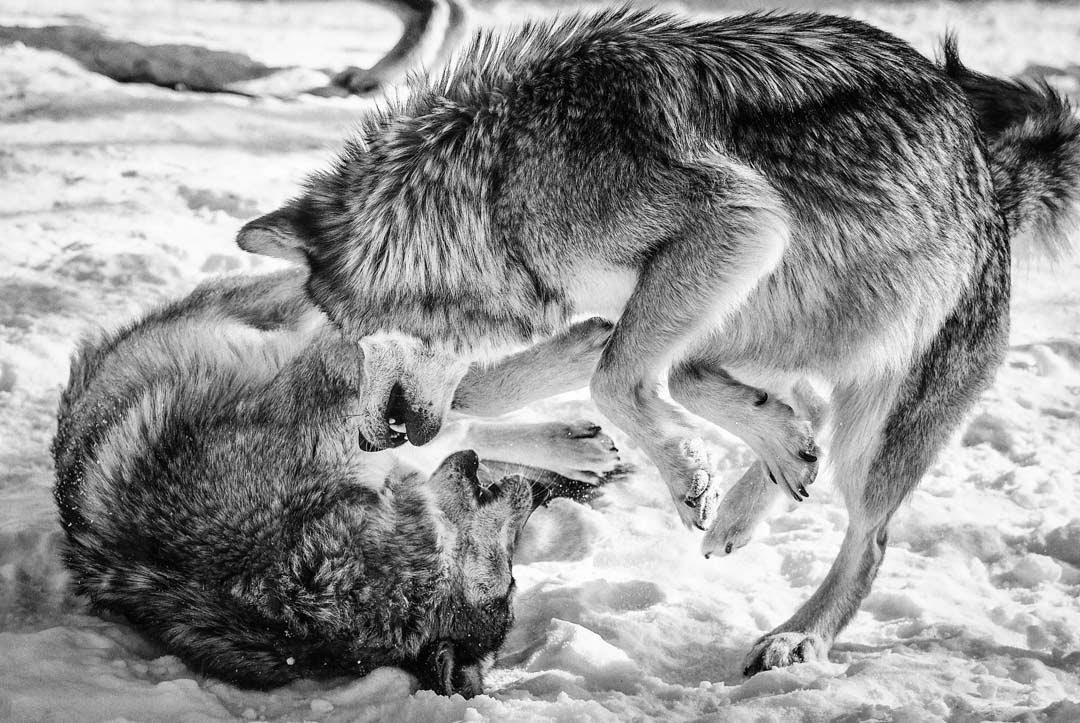
As it stands, the AF is so good and quick that you can hit most sport shots with just that. CF was used without the tracking option and it was adequate for use in non-mission critical uses(again, with the 2.2 firmware). There were some missed sequences, but given the shooting conditions, I'm not sure if the misses were the lens, my lack of experience using the m43 C-AF systems or the dirty glass I was shooting through. If there is any deficiency that we find we will report it.
![]() |
| AF capable of keeping up with these running Mexican Wolves 1/3200, f/2.8, ISO 800 @ 150mm(heavily cropped as well) |
I like the fact that the lens hood can be retracted with a twist of the ring. It stays locked in the deployed position until you use the ring. I wish it did the same when retracted. There were times just pulling the lens out of the bag that the hood would deploy. That is just me being nitpicky, though.
Conclusion
So far, just from this one day of shooting and seeing the results, I am sold on the capability of this lens. It is sharp, handles well, everything is in a great place and the AF performance is top notch. I'm not sure if Olympus could have made a better lens.
Wednesday, February 11, 2015
How I Got The Shot #38 - Dragging The Shutter At The Father/Daughter Dance
While there, I also agreed to get some grab shots in between formal shots. I had my Nikon Df tied up with the portraits, so I broke out the Olympus OMD EM1 with the Olympus 25/1.8 prime lens.
As you can imagine, a dance setting has lots of darkness, filled with bright specular lights randomly bouncing off of every surface and person. This even was no exception.
![]() |
| 1/20, f/2.5, ISO 800 - no flash |
![]() |
| 1/80, f/2.5, ISO 2500 - no flash |
I knew that shooting this way, even at higher ISO, would not give me what I was looking for and I'd have to break out a speed light. I do not have an Olympus specific speed light, but do have plenty of Nikon, so I used the SB-600. It is a little big for the EM1, but I use my fingers to support the weight of the speed light.
This next shot was taken using the flash in manual mode at around 1/16th power and shot directly at the dance floor.
![]() |
| 1/200, f/4, ISO 800 - Flash at 1/16th power |
Next, we bounced the light off the ceiling, which required the SB-600 to be powered to around 1/4 power. There were some pretty tall ceilings.
![]() |
| 1/200, f/2.8, ISO 1250 - flash at 1/8 power |
As you might have noticed, the shutter speed on these images were running around 1/200th.
What happens if we "drag the shutter"? Dragging the shutter is a term used when you purposefully leave the shutter open for a longer duration and freeze the action of the moving subjects with the flash pulse.
![]() |
| 1/15, f/2.8, ISO 1250 - flash at 1/8 power bounced off ceiling |
Here are some more examples:
![]() |
| 1/15, f/2.8, ISO 1250, flash at 1/8 bounced off ceiling |
![]() |
| 1/15, f/2.8, ISO 1250, flash at 1/8 bounced off ceiling |
For those interested in my main presence there - here are some of the portraits!
Lighting setup was pretty simple, main light to camera left(AB400) at 1/8 power, secondary light(AB400) to camera right at 1/16 power. Both through umbrella boxes.
Nikon Df with Nikkor 50/1.8D at 1/200, ISO 200, f/4
Processed in Lightroom 5.7 using Nik Analog Efex(Bokeh) and Nik Silver Efex(custom B&W - base Panatomic 25 with a bit of Film Noir 3 type settings).
We wanted a quick in and out process so that the families could have as much time having fun as possible.